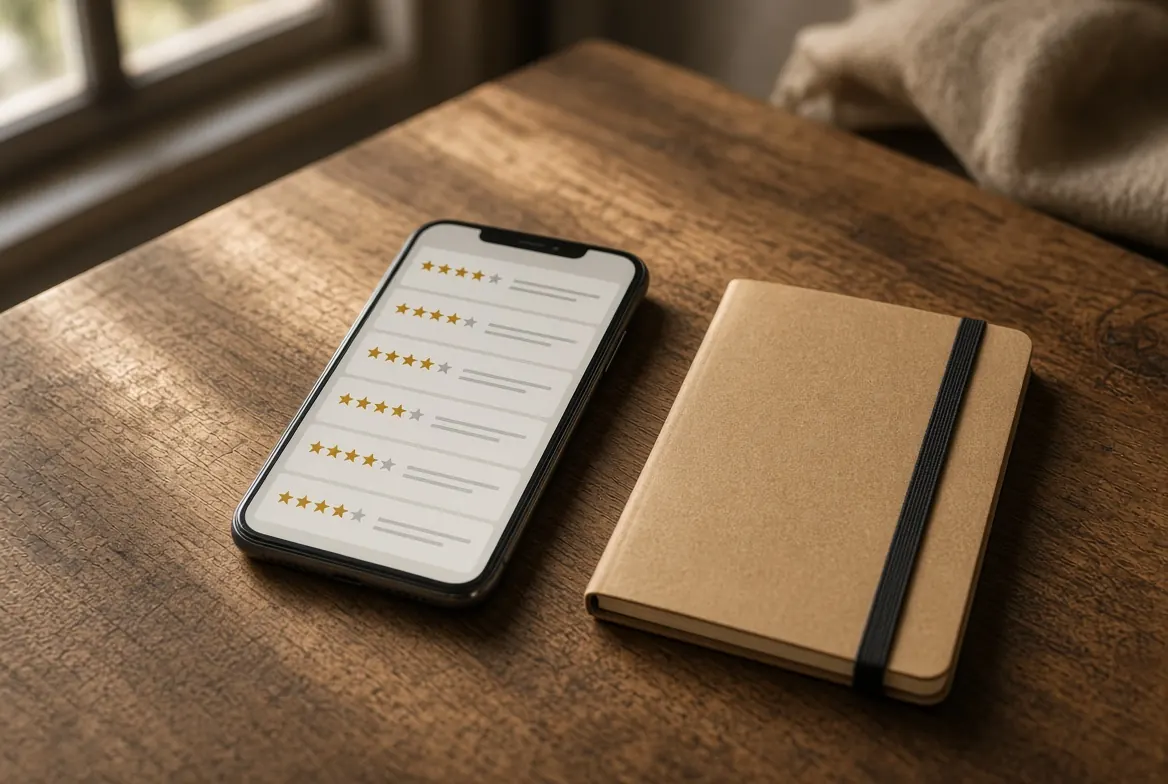
Reviews decide which listing gets the tap. A business with recent reviews and a solid average will get more calls from the map pack than a better business with a handful of old ones. That is the market. The businesses that win it have a system. The ones that lose it hope someone leaves a review, or they try a shortcut that creates a bigger problem.
This is the system that works, and the tactics that do not. It assumes your profile exists and you can edit it. If the listing is suspended or missing, fix that first: Google Business Profile suspended or not showing. If the profile itself is thin, start with what to fix on the profile before you spend on ads.
Reviews sit next to the site. The profile gets the tap. The site and the reply get the trust. Local SEO starts with the site. Reviews are the public proof that the site is telling the truth.
Why reviews matter more than a slogan
In the map pack, the rating and the review count are on the listing before anyone reads your description. A 4.6 with 80 reviews beats a 5.0 with 4 reviews for most people, because the 4 looks unfinished. A 3.9 with detailed recent reviews can beat a 4.8 with three generic ones, because the detail sounds real.
Reviews also feed the ranking. Google has said reviews are a factor in local ranking. Volume, recency, and the content of the reviews all show up in practice. A profile that has not had a review in a year looks dormant. A profile that gets a few a month looks alive.
The site should use them too. A service page with no proof asks for trust. A service page that points at recent reviews, or quotes them with permission, gives a reason to call. That is standard on the sites we build, from contractor sites to dental sites to law firm sites.
When to ask
Ask when the experience is finished and the customer is happy. Not in the middle of the job. Not three weeks later.
For a contractor, that is the day the job is done or the day after, when they are looking at the result. For a practice, that is after a visit that went well, often by text the same day. For a firm, that is when a matter closes, within the rules of your jurisdiction. For a restaurant, that is not usually a text blast. A quiet ask from the staff, or a line on the receipt, is enough.
The ask should be easy. A text or email with a direct link to your Google review form. Not “search for us and leave a review.” Not a link to your homepage. The direct link. Every extra step loses people.
Front desk, the person who closed the job, or an automated text from the system you already use. Pick one owner. If everyone owns it, nobody sends it.
How to ask without being strange
Short. Specific. No speech.
“Thanks for having us out today. If you have a minute, a Google review helps other people in [town] find us: [link].”
That is enough. Do not write the review for them. Do not tell them what star rating to leave. Do not offer a discount, a free item, or an entry in a draw. Incentives for reviews violate Google’s policies and create reviews that read as fake. They can also get the reviews removed and the profile flagged.
Do not gate the ask. A system that sends happy customers to Google and unhappy customers to a private form is review gating. Google prohibits it. It also produces a review profile that does not match reality, which is how you get surprised by a public complaint you thought you had contained.
Ask everyone who had a normal, completed experience. You will get some negatives. That is fine. A perfect 5.0 with 200 reviews looks less believable than a 4.7 with a mix, and the reply to the negative is part of the trust.
Want the review ask built into the site and the close-out? Tell us how you finish a job or a visit. We'll scope the site and the profile together.
Get a Project Quote →The link, the QR code, and the follow-up
Get the short review link from the profile. Put it in the text. Put it in the email. Put a QR code on the invoice, the front desk card, or the finished-job leave-behind if that fits the business. One link. Do not send people to Yelp, Facebook, and Google in the same message. Google is the one that moves the map pack. Start there.
One follow-up is enough. A second text two days later if they have not left one. Not five. Not a weekly nag. The people who will leave a review will leave it when it is easy. The people who will not, will not.
Track that the ask went out. A shared note, a checkbox on the job, a step in the CRM. If you cannot tell whether last week’s customers were asked, the system is not running.
What a useful review looks like
You do not write it. You can notice what the useful ones contain, so you know the ask is working.
Useful reviews name the work and the place. “Replaced the roof on our house in [neighborhood]. Crew was on time, cleaned up, explained the ridge vent.” That helps the next customer and it associates the business with the service and the area.
Generic reviews do less. “Great service, highly recommend!” is fine. It does not help someone deciding between three roofers. You cannot require detail. You can make the experience specific enough that detail is what they remember.
Never offer suggested wording that is really a keyword list. “Mention roof repair and [city]” is a small step from fake. Let them write it.
Replying to good reviews
Reply to all of them. A reply is a signal that the business is present, and it is a chance to add a true detail without stuffing.
“Thanks, Maria. Glad the crew could get the tear-off done before the rain.” That is enough. Do not paste the same sentence on every review. Do not turn the reply into an ad with a list of services and towns. Do not confirm private details a customer did not share. For a medical or legal practice, do not confirm they are a patient or a client in a way that discloses something they did not already say in public.
Short, specific, human. That is the whole reply.
Replying to bad reviews
Reply once. Calmly. Do not argue the facts in public. Do not diagnose, quote a file, or reveal anything the reviewer did not already put in the review.
“Sorry this was the experience. Please call the office at [number] and ask for [name]. We want to make it right.” That is a complete reply.
What does not work: a defensive paragraph, a point-by-point rebuttal, sarcasm, or a reply that blames the customer. Future customers read the reply more carefully than the review. A calm reply to a harsh review is often more convincing than the five-star above it.
If the review is fake, from a competitor, or about a business that is not you, you can report it. Google removes some of these and leaves others. Report it, reply briefly that you do not have a record of the visit and that you are happy to look it up if they call, and then stop. Do not start a second thread.
If you got a cluster of bad reviews after a real failure, fix the failure. The replies will not outrun an unresolved pattern. A roof leak that was not repaired, a front desk that does not answer, a job that ran three weeks late. The review is the symptom.
What not to do
These are the shortcuts that create a worse problem than a thin review count.
Buying reviews. Against Google’s policies. The reviews can be removed, and the profile can be suspended. A suspension costs more than a slow review build. See what to do if the profile is suspended.
Incentives. A discount, a gift card, a free appetizer, an entry in a raffle. Not allowed. It also produces reviews that sound like ads.
Gating. Happy path to Google, unhappy path to a private form. Not allowed.
Review pods and exchanges. You review me, I review you, across businesses that were never customers. These get detected and removed.
Employee reviews written as customers. Staff can be customers if they genuinely were. A stack of reviews from people who work there, in the same week, is a pattern.
Writing them yourself from other accounts. Same problem, higher risk.
Asking only the customers you are sure will be glowing, and hiding the rest. That is gating in practice.
The legal version of this, for firms, has extra constraints. Some jurisdictions limit testimonials and results. Follow the bar rules. A Google review the client left on their own is different from a testimonial you solicited with a case result attached. When in doubt, ask less and disclose more. The law firm SEO guide covers what the site can say. The same caution applies to how you ask.
Need a site that makes the ask and the proof obvious? We build the pages and can run the profile. Start with a quote.
Get a Project Quote →How many reviews is enough
Enough to look alive next to the businesses you actually compete with in the pack. There is no universal number.
Look at the three listings that show for your main search. Note their review counts and how recent the latest reviews are. That is the bar. A new business will not match a ten-year-old practice in a month. A steady ask will close the gap. A one-time push of 30 reviews in a weekend will look unnatural and can be filtered.
Recency matters as much as total. Ten reviews this quarter beat fifty from 2021. Build the habit. Do not build a spike.
Reviews and the website
The site should acknowledge the reviews without inventing them.
A line near the call to action: “Rated 4.7 on Google from 120 reviews.” True, current, linked to the profile. A short quote from a review, with the first name if that is how it was signed, on the relevant service page. Permission if you are going beyond what they already posted publicly, and extra care in healthcare and legal.
Do not paste 40 reviews into a page to stuff keywords. Do not add reviews the customer did not write. Do not let the review widget slow the page to a crawl. A fast page with a true rating and a link beats a slow page with a carousel.
This belongs in the build. A website design project for a local business should know the review count and the ask, not discover them after launch.
Industry notes
Contractors and roofers. Ask the day the job is done. The customer is looking at the work. A text that afternoon gets more reviews than a request with the final invoice three weeks later. Job photos on the profile in the same week reinforce it. More on the site side in SEO for construction companies.
Dentists and doctors. Ask after a routine visit that went well, not after a procedure the patient is still recovering from. Do not disclose treatment in the reply. Insurance and booking questions belong on the site, not in a review thread. See SEO for dentists and SEO for doctors.
Law firms. Ask when a matter is closed, within your jurisdiction’s rules. Do not discuss case details in a reply. A thank-you and an offer to talk offline is the safe reply.
Consultants. Fewer clients, so each ask matters more. A specific review from a recognizable type of client is worth more than volume. See SEO for consultants.
Hospitality. Do not text every table. A line on the receipt or a small card is enough. Respond to food and service complaints the same day if you can. A late reply to a cold meal review reads as indifference.
Negative patterns and operations
If the last ten reviews mention the same thing, that is not a marketing problem.
Wait times. Communication. Cleanup. Billing surprises. A phone that is not answered. Fix the operation. Then the reviews change. A reply template will not.
We will not write a review strategy that papers over a real failure. If the site and the profile are fine and the reviews are the constraint, the constraint is usually the experience. Say so. Then fix what you can on the page so the next customer knows what to expect.
Reporting and removal
You can report a review that violates Google’s policies: spam, conflict of interest, off-topic, prohibited content, harassment. Reporting is not a way to remove a review you disagree with. A customer who is unhappy about a real visit is not spam.
Report clearly. Do not file the same report every day. Do not review-bomb the reviewer. If Google removes it, good. If not, your reply stands, and you move on.
For a wave of fake reviews, document the pattern, report them, and do not engage reviewer by reviewer beyond a short factual reply. If it is severe, the appeals and support routes in the suspension guide are the next step, not a new profile.
What we set up for clients
On a profile engagement we do three things with reviews.
We make the direct link easy to send, and we put the ask into the close-out the business already does. We reply, or we draft replies for the business to send, in a voice that sounds like them. We watch for spikes, fakes, and a profile that has gone quiet.
We do not buy reviews. We do not write them. We do not gate them. That is the whole policy. It is also the policy that keeps the profile standing.
Ongoing review work sits inside Google Business Profile optimization. The site work sits in web design or a redesign. They support each other. Neither replaces the ask you send after the job.
Ready for a number? Tell us how you finish work today and what the profile looks like. We'll scope the ask, the replies, and the site if it needs it.
Get a Project Quote →A simple month-one plan
Week 1: get the direct link, write the one-line ask, decide who sends it. Week 2: send it after every completed job or visit. Reply to whatever comes in. Week 3: add a QR code or a line on the invoice if the text alone is not enough. Week 4: look at what the reviews mention. Fix the one operational complaint that shows up twice. Keep asking.
That is the system. It is not a campaign. It is a step in the work you already do.
Frequently asked questions
Can we offer a discount for a review? No. Incentives violate Google’s policies and produce reviews that do not hold up.
Should we reply to every review? Yes. Short and specific on the good ones. Calm and offline on the bad ones.
What if we have no reviews and a competitor has 200? Start the ask this week. Do not buy a block to catch up. Recency and a steady pace close the gap. A spike will not.
Can we move reviews from Facebook or Yelp? No. Reviews belong to the platform they were left on. You can ask a happy customer to also leave one on Google. You cannot copy theirs over.
Do reviews help the website rank? They help the map pack, and they help the site convert. They are not a substitute for service pages. Build both.
What about anonymous bad reviews? Reply once, factually, without private details. Report it if it violates policy. Do not start a fight in the thread.
The short version
Ask when the work is done. Send a direct link. Do not pay, gate, or write the reviews. Reply to all of them. Fix the operation if the same complaint repeats. Put the true rating on the site.
That is how a listing earns the tap, and how the tap becomes a call.
Get a project quote to have the ask and the site scoped. Read what to fix on the profile first if the listing itself is thin. Read suspended or not showing if the listing is gone.
Names, photos, and what customers notice
People read the name on a review and the photo if there is one. A stack of reviews from accounts with no history and no photo looks thinner than a smaller set from accounts that look like real customers. You cannot control who has a photo. You can avoid the pattern that creates the thin look: a weekend of reviews from brand-new accounts, all five stars, all vague.
Real customers leave reviews that mention a person, a street, a material, a wait time, a result. Encourage nothing. Just do the work in a way that gives them something specific to say, and ask while they remember it.
If a reviewer mentions a staff member by name, the reply can thank them without turning into a performance review. “Glad Sam could walk you through the options” is enough. Do not list the rest of the team and their certifications in the reply.
Review velocity and why spikes backfire
Google filters reviews that look unnatural. A business that has averaged two reviews a month and then receives 25 in three days will often see some of those held or removed. Even if they stay, the pattern reads as a campaign to anyone looking at the dates.
Steady is the goal. If you are behind, increase the ask. Do not organize a “review day” where you text the last hundred customers at once. Spread it. The customers from this week’s jobs are enough.
The same applies after a suspension is lifted or a duplicate is merged. Do not celebrate with a review push. Let the normal ask resume.
What to do with a one-star that is actually useful
Some bad reviews are gifts. “They were an hour late and nobody called.” That is fixable. The reply acknowledges it, says what you changed, and stops. Then you actually change it. The next reviews will mention the call. That is how a rating recovers. Not with a burst of five-stars. With the complaint disappearing from new reviews.
Print the last 20 reviews and mark the repeated nouns. Wait. Price. Communication. Cleanup. Mess. Those words are the backlog. Marketing cannot outrun them.
Multi-location reviews
Each location has its own profile and its own reviews. Do not ask a customer in one town to review a different office. The review should land on the profile for the place they visited or the crew that did the work.
If you have three offices, three ask-links. Label them. A customer who reviews the wrong location creates a mess you will explain forever. Staff at each location should have the link for that location, not a shared one.
When you close a location, the reviews do not move cleanly. Plan the closure. Update the profile. Do not leave a closed office collecting reviews about a locked door.
Seasonal businesses
A roofer’s review volume should rise after storm season if the ask is in the close-out. If it does not, the ask is not happening, no matter what the busy season felt like. Check the send log in October if the season was August.
A practice that asks only in January will look dormant by June. Put the ask on the visit, every visit that qualifies, all year.
The owner and the voice
Replies should sound like the business, not like an agency. If you would not say it at the counter, do not put it in the reply. We draft in that voice and you send, or you reply and we flag the ones that sound like a press release.
“We strive to provide exceptional customer experiences” is not a reply. “Sorry we missed the window. Call me and I’ll get someone out Thursday” is a reply.
Measuring whether it is working
Count three things each month. Reviews received. Reviews asked for, if you can. The one complaint that repeated.
Ignore follower counts and profile views as a scoreboard. A listing can be viewed and not trusted. Reviews are the trust. If asks are going out and reviews are not arriving, the link is wrong or the timing is late. If reviews are arriving and calls are not, the site or the category is the constraint. Different fix. The profile setup guide is the place to check category, photos, and hours.
A word on competitors’ reviews
You will be tempted to study a competitor’s reviews and copy their ask. Read them for the complaints, not for the praise. The complaints are the gaps you can close in the experience and then mention, truthfully, on the site. “We call before we arrive” is a line that belongs on a page if you actually do it. It does not belong in a fake review.
Do not review your competitors. Do not respond to their reviews. Do not report their real reviews because you dislike them. Stay on your own listing.
Getting started this week
Get the link. Write the one sentence. Send it after the next five finished jobs or visits. Reply to whatever is already on the profile, including the old negatives you have been ignoring. That reply, a year late, still reads as presence.
Then keep the step. Reviews are a byproduct of finished work plus an easy ask. They are not a project you launch and complete.
If you want the ask, the replies, and the site in one scope, get a project quote. If you want a look at the site first, start with the free audit.
Reviews and paid ads
If you run ads, the profile still matters. Ad extensions and location assets pull from the profile. A thin profile with few reviews makes the ad look thinner. A complete profile with recent reviews makes the same ad look like a business someone has hired.
Do not send ad traffic to a homepage that ignores the reviews. The landing page should match the ad and should carry the same proof. We build those pages as part of a site project or as landing pages when the campaign needs its own URL. The review ask does not change because you are running ads. The customers from ads get asked the same way as the customers from the map.
What “enough detail” means in a reply
A reply does not need to be long to be useful. It needs to show a person read the review.
Name the work if they named it. Name the town if they named it. Offer a next step only on the negative. On the positive, stop. A reply that adds a paragraph of services after a thank-you is an ad. People can tell. So can Google, in the sense that stuffed replies do not help and can look like the rest of a stuffed profile.
If you are replying to ten reviews in a sitting, vary the sentence. The same 12 words on every review is a template, and it reads as one.
Ready for a fixed quote?
Tell us about the business and what the site needs to do. We'll come back with a scope and a number. No hard sell.
Get a Project Quote →Or start with a free auditGoogle Business Profile Suspended or Not Showing: What to Check First
Profile suspended, removed, or just not showing in the map pack. How to tell which problem you have, what to fix before you appeal, and what not to do while you wait.
Google Business Profile: What to Fix Before You Spend on Ads or a Redesign
The Google Business Profile fixes that move the map pack. Categories, name and phone, hours, photos, the description, and the mismatches that keep a real business off the map.
Google Business Profile Suspended: What to Do Next
Your Google Business Profile got suspended. Here's how to find the reason, fix it, gather the right evidence, and appeal once, plus the mistakes that make suspensions worse.